
India’s economy revival = Calibrated Re-opening with support measures (c’re) + Benign approach for migrant workers (be’mw)
A country of over 1.3 billion people where livelihood is dependent on so many kinds of jobs that one could engage in. What really are the dependencies for such jobs? Its undoubtedly people of all kinds i.e., a mix of Unskilled, Semi-skilled, and Skilled. The progress of our country has always been highly dependent on the role that these workers play in such kinds of jobs.
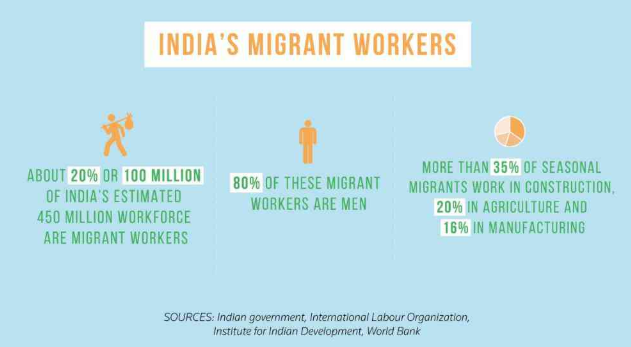
They are an informally employed force which comes from several states like Uttar Pradesh, West Bengal, Bihar, Rajasthan, Odisha, Madhya Pradesh, North East and are in excess of 100 Million+ aka migrant workers and their size translates to over 20% of the workforce of our country. What makes them special are their specific skills that are quintessential to several key industries. Their earnings support the even bigger Rural India since most of the time they come back and also participate in the agricultural initiatives.
Migrant workers leave the comfort zone of their hometown for getting jobs in cities near and far and their contribution in areas connected to the ones below cannot be questioned…
- Manufacturing — factory workers
- Construction — masons and construction workers, electricians, plumbers, painters, and the likes
- Gems & Jewellery — gem polishers
- Arts & Crafts — skilled artisans
- Garments/Clothing — stitched sequins on garments
- Hospitality — hotels
- Transportation/Supply Chain — across industries
- Retail — Also includes umpteen no of sweets and savories outlet alongwith retail backend support
- Mines and Quarries — digging and extracting
- Domestic work — residential and commercial
There are some pertinent questions that justify the above analogy :
Will these industries function independently of them?
Who will run machines in the factories post the lockdown ?
Who does the majority of the dirty work that polished people a lot of times want to stay away from?
Who has been the biggest loser of this pandemic?
What will happen if the Migrant workers decide not to come back?
Here are the views of 2 Industry experts on the aftermath of this episode…
In the words of Mr. Raghunath Rajan, Founder of Ritech Group of Companies which has been playing an instrumental role in the construction industry having completed more than 350+ premium projects…
Any Industrial Manufacturing establishment, Oil and Gas, any Infrastructure work, Indian Railways, Metro Railways, Micro Tunnelling projects, Highways, Roads, Dams, Bridges and similar industries have all had a huge impact in their success because of the active presence of migrant workers. All of these directly lead to the overall growth of the economy and due to this, the impact will be huge and as a result, the overseas funding agencies supporting projects will also take a backseat.
In the words of Mr. Moiz Gabajiwala, who is the 2nd generation entrepreneur running brands like Mechanix and shaping the growth and development across age groups in the toy industry…
The need for migration is more skewed towards the industries. In other words, industries need migrants more than migrants need to migrate. The long-run journey will be highly challenging if these migrants refuse to come back. The machinery will stop producing without people, the trucks will stop running without people and the boxes will not move by themselves. Industries need these migrant workers and it is the responsibility of the promoters to ensure that their dreams are not shattered but atleast a flicker is maintained and the hope is alive. This is the least an Entrepreneur is responsible to do…
All media reports in the initial days kept highlighting the impact on corporate jobs however a much bigger and painful story has been the plight of migrant workers. We all have read this through various reports over the past weeks. What do you think about the millions of jobless migrant workers?
Families of the migrant worker had to literally transfer money to them through various means to get them back. What were the employers doing at this stage?
The behavior of employers was below par at a time when the workers wanted them the most…one could wonder why would the employers not support the workers on whom the business was running efficiently and now was the time to develop the best of the relationship. Was it sheer short-sightedness?
Media spread in the nooks and corner of the country have asked the migrant workers on their experience of the pain that they have been going through and their response in different words have been nothing less than deplorable
- Media news reported that over 80% of the migrant workers accused their employers of being unimaginably niggardly and that too at such a time…when the question was of survival
- ‘I will never come back’ to this city post the lockdown and I would rather stay with my family even if I earn half of what I earned there
- A pledge not to come back to his work area again…
- Being penniless and starving in an area which is hundreds of kilometers away from their home town…
- They didn’t even have enough money to recharge their phones or reach out to their family to share their well-being
- Working gracefully to starving and standing in the queue for free food has been nothing less than traumatic for them and this would be taking a long time to heal
- The intensity of the struggle was such that they didn’t even have enough money to buy the ticket for the special train introduced by the Govt.
Who came to their rescue were organization representatives who were into NGO, charities, local volunteers, government bodies, local police, political parties, and here also they had to do tough negotiation since there always was immense pressure from locals who always had an upper hand as to who should be the recipient.
Who is responsible for the above situation — at the base level, it is the employer aka businessman who has refused to pay them the required wages amidst the pandemic.
The above is what they feel however, it would be quite difficult for them since the entire workforce may not be able to keep themselves occupied at lower wages within their village or vicinities. Also, financial pressures might force them to migrate again.
The real Catch-22 situation would be when the market situation normalizes only to realize that the support system needed to manage is not available. The situation of scarcity obviously has severe implications on Cost leading to Inflation.
With such remorseful treatment, hope Governments, Industries, and MSME’s will do all that is required to build a long term sustainable relationship since the reluctance of migrant workers to return could mean labour shortages which will have a huge continued impact hitting the Indian economy.
Comments
Post a Comment